www.jjw3.com
>
Math1431
OR
Math1431H
>
Math1431 Notes
> Sullivan Chapter 5 Notes
Chapter 5: Probability
Section 5.1: Probability Rules
Knowledge Prerequisites
declarative knowledge (definitions)
none
procedural knowledge
none
conditional knowledge
none
Learning Goals
declarative knowledge (definitions)
probability
outcome
law of large numbers
[probability] experiment
sample space,
S
random event
probability rules
probability model
unusual event
empirical [a.k.a., frequentist] probability
equally-likely outcomes
classical [a.k.a., classicist] probability
subjective probability
fair
coin,
fair
die
procedural knowledge
verify probability models
write complete sample space for a given situation
use complete sample space to calculate probabilities using classical approach
calculate probabilities using classicist approach
approximate probabilities using frequentist approach
construct a probability model using given data
conditional knowledge
know when it is appropriate to use the concept of probability
know the importance of the concept of randomness or chance in probability
interpret value of probability
know the difference between classicist and frequentist approaches
know when to use classicist or frequentist approach
understand why the empirical approach only results in approximate probabilities
identify when an event is considered unusual
important notes
tests will not include questions on playing cards or roulette
answers
must
be in complete sentences using the correct symbols, e.g.,
P
(
x
= hearts) = 1/4
answers to probability questions can be in any of the following form: unreduced fraction, reduced fration, decimal, or percentage
Section 5.2: The Addition Rule and Complements
Knowledge Prerequisites
declarative knowledge (definitions)
Section 5.1
:
probability
outcome
sample space,
S
random event
probability model
unusual event
procedural knowledge
Section 5.1
:
use complete sample space to calculate probabilities using classical approach
calculate probabilities using classicist approach
conditional knowledge
Section 5.1
:
know when it is appropriate to use the concept of probability
know the importance of the concept of randomness or chance in probability
interpret value of probability
identify when an event is considered unusual
Learning Goals
declarative knowledge (definitions)
disjoint [a.k.a., mutually-exclusive] events
Venn diagrams
addition rule for probability
general addition rule for probability
contingency table [a.k.a., two-way table]
complement of an event,
E
c
complement rule for probabilities
keywords for probability:
or
and
[sometimes you will need to identify
and
even though word is not used]
not
procedural knowledge
how to calculate the probability of an event using the addition rule
how to calculate the probability of an event using the general addition rule
how to calculate the probability of an event using the complement rule
how to calculate the probability of an event from a contingency table
know how to use algebra to rearrange any probability rule to solve for an unknown quantity
conditional knowledge
how to determine which probability rule to use for a given problem
how to determine if two events are disjoint
how to identify the complement of an event
know that probability, proportion, and percentage are equivalent
important notes
tests will not include questions on playing cards or roulette
answers
must
be in complete sentences using the correct symbols, e.g.,
P
(
x
= hearts) = 1/4
answers to probability questions can be in any of the following form: unreduced fraction, reduced fration, decimal, or percentage
Section 5.3: Independence and the Multiplication Rule
Knowledge Prerequisites
declarative knowledge (definitions)
Section 5.1
:
probability
outcome
sample space,
S
random event
probability model
unusual event
procedural knowledge
Section 5.1
:
calculate probabilities using classicist approach
conditional knowledge
Section 5.1
:
know when it is appropriate to use the concept of probability
know the importance of the concept of randomness or chance in probability
interpret value of probability
identify when an event is considered unusual
Learning Goals
declarative knowledge (definitions)
independent events
multiplication rule for probability
procedural knowledge
how to calculate the probability of an event using the multiplication rule
conditional knowledge
understand that independence events and disjoint events are different concepts
understand that independence events and disjoint events are different concepts
understand when repititions of a random phenomenom are independent, the probability of future events does not change
how to use the multiplication rule for a given problem
know how to use algebra to rearrange any probability rule to solve for an unknown quantity
important notes
tests will not include questions on playing cards or roulette
answers
must
be in complete sentences using the correct symbols, e.g.,
P
(
x
= hearts) = 1/4
answers to probability questions can be in any of the following form: unreduced fraction, reduced fration, decimal, or percentage
Section 5.4: Conditional Probability and the General Multiplication Rule
Knowledge Prerequisites
declarative knowledge (definitions)
Section 5.1
:
probability
outcome
sample space,
S
random event
probability model
unusual event
Section 5.3
:
independent events
multiplication rule for probability
procedural knowledge
Section 5.1
:
calculate probabilities using classicist approach
conditional knowledge
Section 5.1
:
know when it is appropriate to use the concept of probability
know the importance of the concept of randomness or chance in probability
interpret value of probability
identify when an event is considered unusual
Section 5.3
:
understand that independence events and disjoint events are different concepts
conceptually identify if two events are independent
know how to use algebra to rearrange any probability rule to solve for an unknown quantity
Learning Goals
declarative knowledge (definitions)
keyword for probability:
given that
[sometimes you will need to identify
given that
even though word is not used]
conditional probability
general multiplication rule for probability
N
(
E
)
procedural knowledge
how to calculate the probability of an event using the conditional probability rule
how to calculate the probability of an event using the general multiplication rule
how to calculate the conditional probability from values in a contingency table
how to use the general multiplication rule to calculate the probability from values in a contingency table
how to use conditional probability to determine if two events are independent, i.e., if
P
(
F
|
E
) =
P
(
F
)
conditional knowledge
how to identify which probability rule to use for a given problem
identify the difference between
P
(
E
) and
N
(
E
)
how to use the conditional probability rule for a given problem
how to use the general multiplication rule for a given problem
know how to use algebra to rearrange any probability rule to solve for an unknown quantity
important notes
tests will not include questions on playing cards or roulette
answers
must
be in complete sentences using the correct symbols, e.g.,
P
(
x
= hearts) = 1/4
answers to probability questions can be in any of the following form: unreduced fraction, reduced fration, decimal, or percentage
P
(at least 1) = 1 –
P
(none)
Chapter 5: Required Formulas – Need to Know for Tests
Approximating Probabilities Using the Empirical Approach:
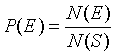
Approximating Probabilities Using the Classical Method:
Addition Rule for Disjoint Events:
P
(
E
or
F
) =
P
(
E
) +
P
(
F
)
General Addition Rule:
P
(
E
or
F
) =
P
(
E
) +
P
(
F
) –
P
(
E
and
F
)
Complement Rule for Disjoint Events:
P
(
E
C
) =
P
(not
E
) = 1 –
P
(
E
)
Multiplication Rule for Independent Events:
P
(
E
and
F
) =
P
(
E
) *
P
(
F
)
Conditional Probability Rule: